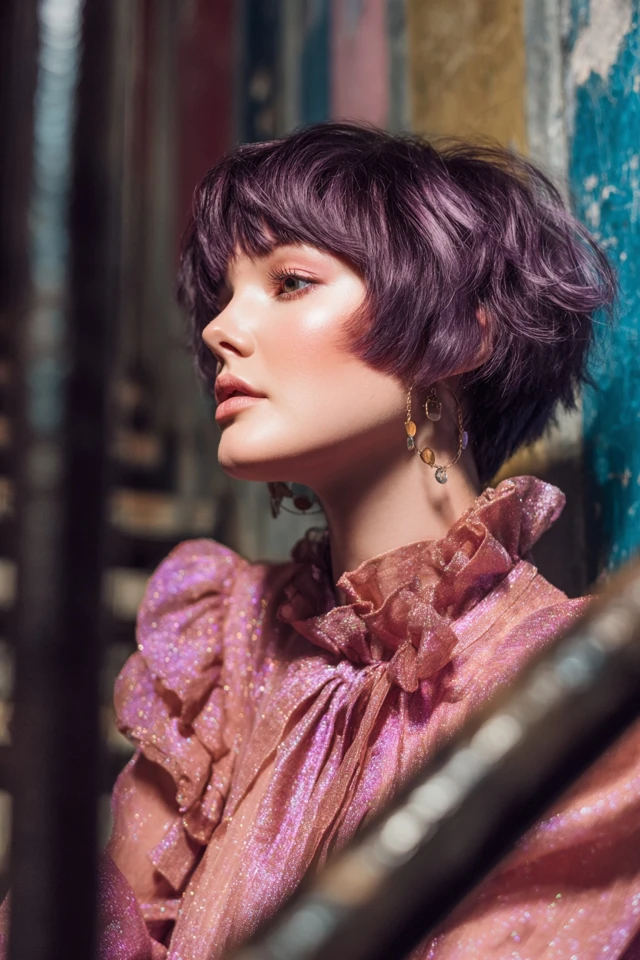
Shoulder-Length Razor Haircut
- Words by
- Julio Arco
- Published
- Reading
- 5 min
Short textured layered haircuts combine two separate ideas: layers change the length of your hair from one section to the next, and texture changes how the ends and surface look and move. Choose layers for shape and lift, texture for softness and a lived-in finish, and ask your stylist for both when you want a cut that styles itself.
A razor is one of the tools that gets you there. It tapers the ends instead of cutting them blunt, which gives the wispy, feathered edge you see in most of the cuts below.
What is the difference between a textured and a layered haircut?
Layering is about structure. Shorter pieces sit over longer ones, so the hair gains volume, movement or a rounded shape. Texturing is about the edges and surface: the ends are thinned, chopped into or tapered so they separate instead of lying in one solid line.
You can have one without the other. A blunt bob with a few long layers has structure but little texture. A one-length cut with razored ends has texture but no layers. Most short styles you see online use both, which is why the two words get mixed up.
Through the lens of evidence-based design, I'd think about texture first. A softly broken edge catches light differently from a solid line, so the same color reads as lighter and more dimensional.

Which short textured layered cuts are worth asking for?
Textured pixie
Very short at the sides and nape, longer on top, with the top thinned or razored so it can be pushed in any direction. It suits fine hair that needs lift and anyone who wants to be out the door in five minutes.
Choppy bob
A chin-length bob with visible, uneven ends. It is one of the easiest ways to wear choppy layers for short hair without losing length entirely.
Textured bob for thick hair
Thick hair tends to form a triangle in a plain bob. Ask for internal layers, which are shorter pieces hidden under the top, to remove weight while keeping the outline neat. A razor or thinning shears at the ends keeps it from puffing out.
Short shag
Layers start high, around the crown, and the ends are feathered. It works well on wavy and curly hair because the shape gives each curl room. Curly hair is usually best cut dry or by someone who works with curls, so say so when you book.
Shoulder-grazing razor cut
If you are not ready to go short, a razored cut at the collarbone gives the same soft ends. See the shoulder-length textured haircut and the short razor cut for more examples.

Which cut suits your hair type?
- Fine hair: shorter, blunter perimeter with light layers on top. Heavy thinning can make fine hair look sparse.
- Thick hair: longer layers and internal weight removal, so it sits closer to the head.
- Short textured layered haircuts for straight hair: choppy, razored ends add the movement straight hair lacks, and a slightly graduated back adds shape.
- Wavy or curly hair: rounded layers, a shag or a curly bob, with less aggressive razoring to limit frizz.
A razor suits most hair, but on very dry or frizz-prone hair a stylist may prefer scissors. A fit problem with a cut is usually a communication problem, so bring a photo and say how much time you will spend styling.

Should you add a fringe?
Short textured layered haircuts with fringe are popular because the bangs add softness around the eyes. Wispy, see-through bangs suit fine hair and a longer face. A longer, side-swept fringe is easier to grow out and blends into the layers. If your hair has a strong cowlick at the hairline, ask your stylist before committing to short bangs.
Fringe needs a quick trim every few weeks, so it is not the most low-maintenance choice.
How do you keep it low maintenance?
Low maintenance short layered haircuts rely on the cut doing the work. A few habits help:
- Air-dry or rough-dry with your fingers, then add a light texturizing spray or cream at the ends.
- If you use a flat iron, the American Academy of Dermatology advises dry hair, a low or medium heat setting, and no more often than every other day.
- Detangle wet hair gently. The AAD notes hair is delicate when wet, so a wide-tooth comb works better than a brush.
- Book a trim every 6 to 8 weeks for the shape to hold, sooner for a pixie.
A leave-in conditioner can help with frizz. Board-certified dermatologist Zoe D. Draelos, MD, FAAD, says "You should see less frizz. Your hair should be easier to brush or comb, so you'll have less breakage."
For scalp or hair concerns, check with a dermatologist or your stylist.

What do you wear with a short textured cut?
Short hair puts the neckline and shoulders on display, so they do more work. Open necklines such as a V-neck or scoop balance a cropped cut. High collars and turtlenecks look sharp with a pixie but can bunch against a bob.
As an architect trained in evidence-based design, I'd treat the neckline as the first thing the eye reads after the haircut. Small earrings or close-fitting jewelry keep that area clean, and a soft knit next to razored ends gives a pleasing contrast of textures. For a wavier alternative, compare the shoulder-length wavy haircut or a layered cut with lift.
Frequently asked questions
What's the difference between a textured haircut and a layered haircut?
A layered cut varies length to build shape and volume. A textured cut softens the ends and surface so the hair separates and moves. Many short styles combine both.
What is a textured haircut for female short hair?
It is a short cut, such as a pixie or bob, with ends that are razored, chopped or thinned instead of cut straight across. The result looks soft and slightly tousled.
What are some trendy short, layered haircuts?
Choppy bobs, shags, textured pixies and layered cuts with wispy fringe are common picks. Bring a photo to your stylist to match the length and layers to your hair.
Can fine hair handle a razor cut?
Often yes, if the stylist keeps the razor work light and the perimeter fairly blunt. Too much thinning can leave fine hair looking sparse, so ask for a consultation first.
Filed under Haircuts