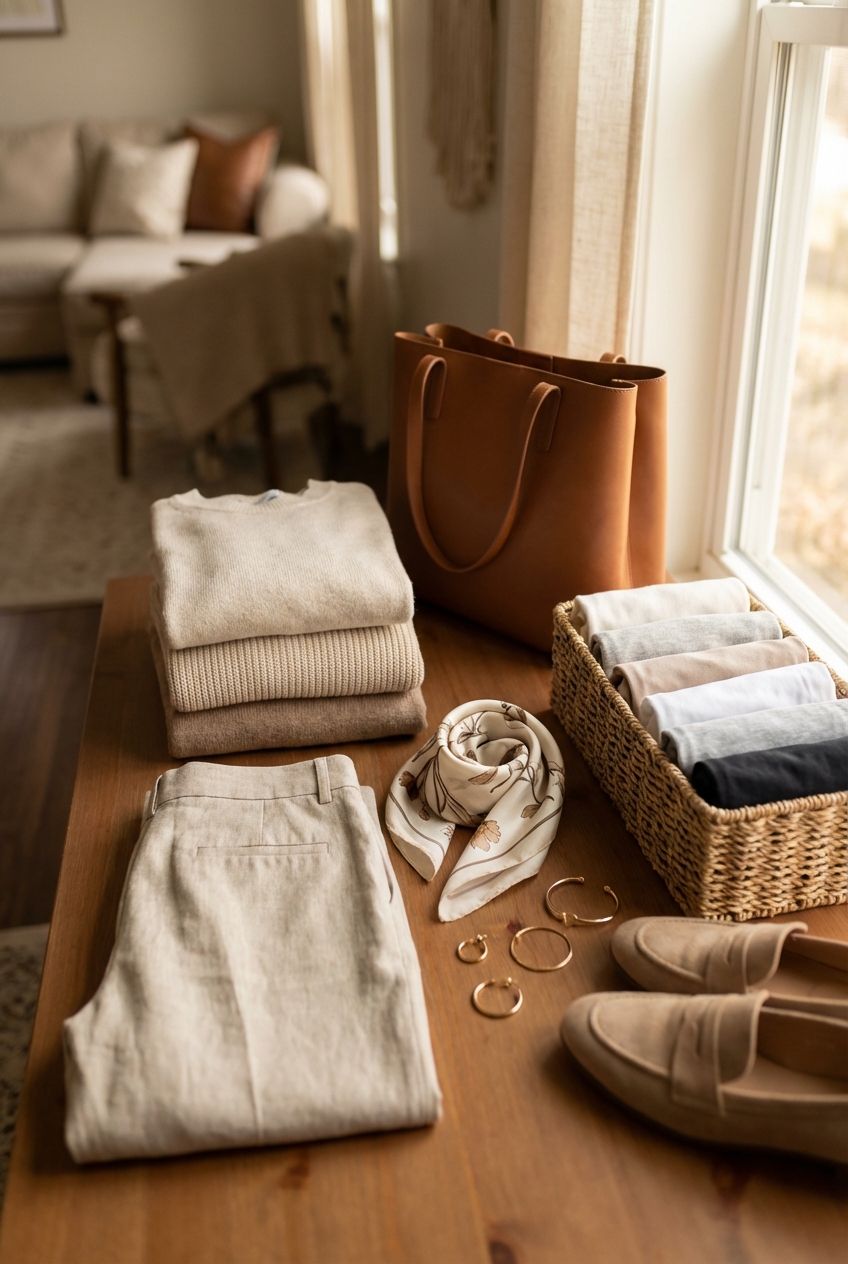
Capsule Wardrobe Tips for Fashion Minimalists
- Words by
- Julio Arco
- Published
- Reading
- 4 min
To build a capsule wardrobe from scratch, empty the closet, keep only what fits and gets worn, choose a tight color palette, then fill the gaps with a short list of versatile pieces. Most people land somewhere between 25 and 40 items, shoes and outerwear included.
If you have a full closet and still feel like you have nothing to wear, that is usually a coordination problem, not a quantity problem. Here is how to build a capsule wardrobe in five steps.

What is a capsule wardrobe?
A capsule wardrobe is a small set of clothes that all work together. Tops, bottoms, layers and shoes share a palette and a level of formality, so almost any two pieces make an outfit.
It does not ban trends. A minimalist might add one trend-forward blazer in their palette instead of several pieces worn twice.
Why build one?
You make fewer decisions in the morning, you see everything you own, and you buy less by accident. There is also a waste angle. The EPA estimated that textile generation in 2018 was 17 million tons, or 5.8 percent of total municipal solid waste, and that same page puts the recycling rate for textiles at 14.7 percent. Owning fewer, longer-lasting pieces is one way to send less of that stream.
Step 1: Declutter your closet
Take everything out and sort it into keep, donate and unsure. For each piece ask: does it fit well, do I wear it, does it suit my current style?
Sentimental pieces are the hard ones. Jasmine Harris-Speight, an MSU Extension Instructor, suggests: "When deciding what to keep, ask yourself: Does this item hold a sentimental place in my heart? Will I miss this item if I get rid of it?" If it matters but you never wear it, store it in a memory box outside the closet.
For the unsure pile, try the hanger trick: turn the hanger backward after you wear something. At season's end, donate whatever still faces the wrong way.

Step 2: Choose a color palette
Pick two or three base neutrals (black, white, gray, navy, beige or camel) and one or two accent colors. Because everything shares a base, any top can meet any bottom.
Through the lens of evidence-based design, I'd look at texture before adding more colors. A matte knit and a glossy satin in the same navy do not read as the same color, because the surface changes how light reaches your eye. Texture gives a small palette variety without adding clutter.

Step 3: Add the essentials
This is the capsule wardrobe checklist most people need. Adjust it to your climate and your week.
- Tops: a white button-down, a striped tee, a neutral sweater.
- Bottoms: slim or straight jeans, tailored trousers, a skirt if you wear them.
- Outerwear: a trench or similar coat and a black blazer.
- Shoes: neutral flats, ankle boots, clean white sneakers.
- Accessories: a leather tote or structured crossbody, and simple jewelry.
Buy to fill gaps, not to reach a number. If you already own a pair of trousers you love, they are on the list.

What is the 3-3-3 rule?
The 3-3-3 rule capsule wardrobe idea is usually described as three tops, three bottoms and three shoes or layers that you mix into a set of outfits. It works well as a trial run or as a capsule wardrobe for travel, where every piece must pair with every other. Treat it as a small-scale exercise rather than a fixed formula, since versions differ.
For everyday life, a larger capsule gives you room for work, weekends and weather. My minimalist travel capsule is a good next read for the packing version.

Step 4: Check fit and fabric
Fit makes a small wardrobe look deliberate. A jacket that pulls at the shoulders is a fit problem, not a you problem. The shoulder seam should sit where your shoulder ends, and trousers should skim rather than strain.
Cotton, wool, linen and silk usually wear well and drape cleanly, though construction matters as much as fiber. Check seams and fabric weight in person when you can. Mixing textures such as a ribbed knit with smooth tailoring keeps neutral outfits from looking flat.

Step 5: Mix outfits and keep the rotation honest
Lay out five outfits before you buy anything else. If a piece only works with one other item, it is probably not a capsule piece.
To keep the closet from creeping back to where it started:
- Follow one in, one out.
- Before buying, ask whether you can wear it with at least three things you own.
- Review at the start of each season.
- Wash gently, line dry delicate fabrics and repair small damage early.
Only about 15% of textiles bought each year are recycled or repurposed, according to Mississippi State University Extension, so repairs and donations of wearable items are worth the effort.

Where to go from here
Once the base works, you can lean it toward a style: edgy, retro or luxury. A few well-chosen accessories change an outfit faster than another sweater will. For a work-focused version, see the capsule for busy professionals.

Frequently asked questions
What is the 3-3-3 rule capsule wardrobe?
It is a mini-capsule exercise, commonly three tops, three bottoms and three shoes or layers combined into many outfits. It suits trips or a short trial of capsule dressing.
How many items should a capsule wardrobe have?
Many people start with about 25-40 pieces including shoes and outerwear. The right number depends on your climate, job and how often you do laundry.
What are the 37 items in a capsule wardrobe?
There is no single official list. A 37-piece capsule is one popular size, and the exact split varies, so build yours from the essentials above and your own routine.
Can I follow trends with a capsule wardrobe?
Yes, sparingly. One or two trend pieces in your existing palette will mix with the core without crowding it.
Filed under Capsule Wardrobe